Building Business Agility via Contingent Talent
Authored by Brian Sim, Managing Director & Country Head, PERSOL Malaysia • 6 min read


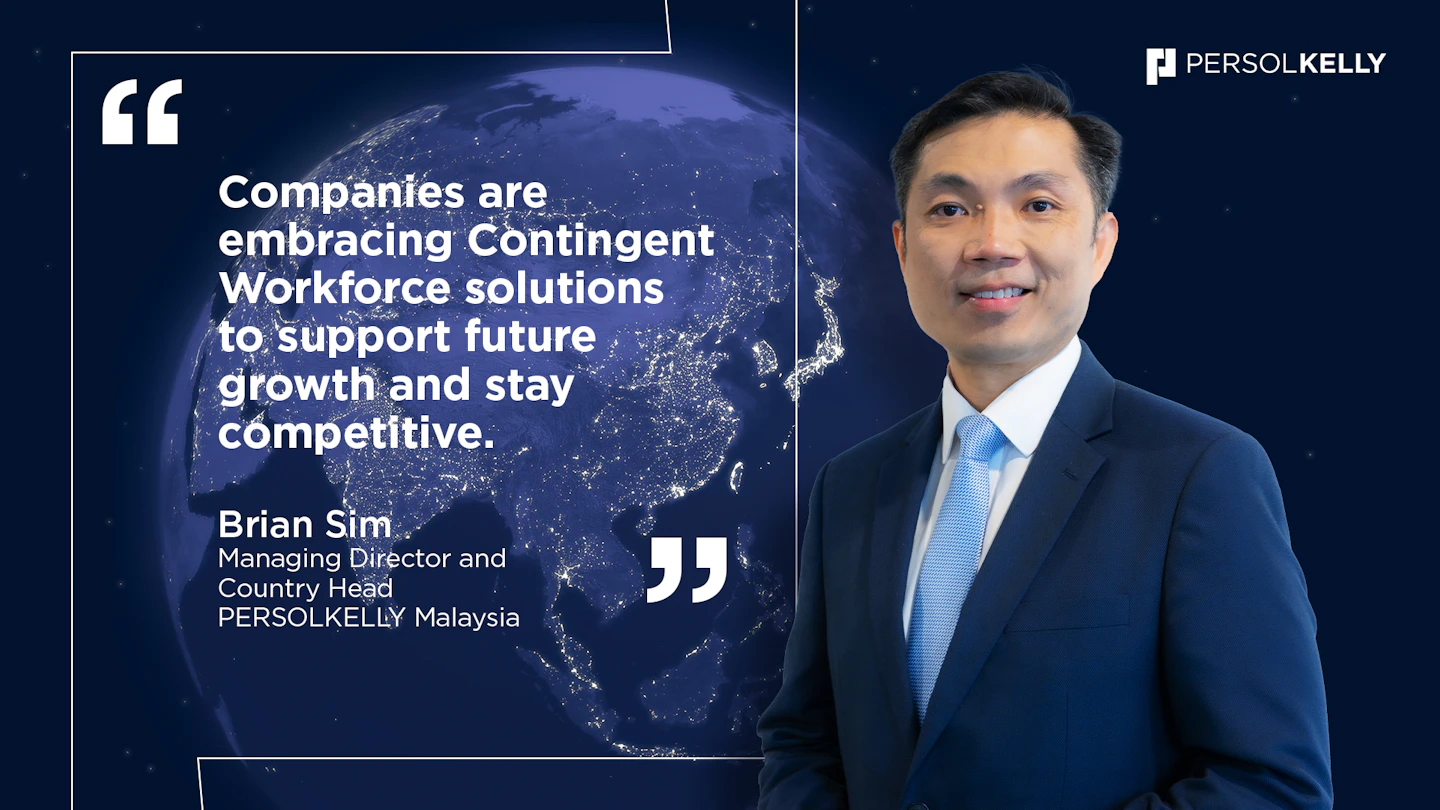
How Can a Contingent Workforce Build Business Agility?
A contingent workforce builds business agility by transforming fixed labor overhead into flexible operational expenses, accelerating speed-to-hire for specialized skills from months to weeks, and enabling enterprises to rapidly scale capabilities during market fluctuations. By strategically deploying independent contractors, interim specialists, and project consultants, organizations bridge critical capability deficits without increasing permanent structural headcount.
While businesses continue to face economic uncertainty across Asia Pacific, it is a tremendous relief to see some light at the end of the tunnel. According to regional economic research, major economies across the region have demonstrated resilient GDP growth. However, recovery is accompanied by new operational challenges: persistent talent shortages, rising overhead costs, and volatile market cycles.
To remain competitive and agile, progressive organizations are fundamentally rethinking their talent architecture. Rather than relying solely on traditional full-time hiring models, enterprise leaders are actively building organizational resilience through the strategic deployment of a contingent workforce.
1. Contingent Workforce Grows in Importance
The modern contingent workforce has evolved far beyond temporary backfill staffing. Today, it encompasses a sophisticated ecosystem of independent contractors, interim executives, specialized consultants, and project-based technical experts.
According to regional workforce surveys, over 65% of enterprise employers across APAC plan to expand their use of contingent talent over the next 24 months. As digital transformation cycles accelerate, businesses face acute short-term skill deficits in cloud computing, data analytics, cybersecurity, and artificial intelligence. Sourcing permanent hires for finite technology implementations often leads to extended recruitment delays and inflated long-term payroll commitments. A flexible contingent model provides instant access to pre-vetted specialists who deliver mission-critical outcomes from day one.
2. How a Contingent Workforce Can Help
A well-structured contingent talent strategy empowers organizations to achieve three core competitive advantages:
Workforce agility is the capacity of an enterprise to rapidly scale, reconfigure, and optimize its human capital in response to external market disruption without incurring structural overhead penalties.
- Operational Cost Optimization: Shifting a portion of talent expenditure from fixed overhead to variable operational expenses allows enterprises to protect cash flow and adapt to fluctuating business cycles.
- Accelerated Speed-to-Market: Sourcing contingent specialists through established workforce partners reduces typical time-to-hire from 60+ days down to 1-2 weeks, ensuring high-priority initiatives launch without delay.
- Specialized Capability Scaling: Organizations can deploy world-class functional specialists for complex transformations, system migrations, or restructuring initiatives without adding permanent headcount.
3. Changing Mindsets in Enterprise Leadership
Successfully leveraging contingent talent requires a fundamental mindset shift from human resources and executive leadership. Historically, contingent workers were often viewed as secondary or transactional personnel. In modern agile organizations, however, contingent specialists are integrated as core strategic contributors.
Forward-thinking leadership teams implement inclusive onboarding, establish clear milestone-driven deliverables, and foster transparent communication channels. By treating contingent workers as valued strategic partners, companies maximize engagement, institutional knowledge retention, and project velocity.
4. High-Demand Skills Across APAC
Across key regional commercial hubs—including Singapore, Malaysia, Hong Kong, and Australia—demand for contingent professionals is accelerating across multiple disciplines:
- Technology & Digital Infrastructure: Cloud architects, cybersecurity consultants, full-stack software engineers, and ERP implementation leads.
- Finance & Regulatory Compliance: Risk analysts, ESG reporting specialists, cross-border tax advisors, and forensic accountants.
- Engineering & Supply Chain: Logistics coordinators, procurement specialists, and advanced manufacturing automation engineers.
- Human Resources & Change Management: Interim HR business partners, organizational restructuring leads, and regional talent acquisition directors.
5. Supporting Your Contingent Workforce Strategy
While the advantages of contingent staffing are decisive, managing a distributed, multi-category workforce introduces operational complexity. Enterprise leaders must effectively navigate local labor compliance, statutory tax withholding, intellectual property safeguards, and vendor management.
Partnering with a specialized regional workforce solutions provider ensures total compliance governance, consolidated payroll administration, and seamless talent scalability across multiple Asia-Pacific jurisdictions.
The Compliance Backbone
The flexibility of a contingent model rests on an invisible foundation: compliance. Every contractor engagement carries statutory obligations—tax withholding, social contributions, working-time rules, and contractor-classification rules that differ by jurisdiction. Get these wrong and the cost savings reverse quickly through penalties and retroactive liabilities. This is the least glamorous part of contingent workforce strategy and the most important reason to work with a specialised partner: the compliance backbone has to exist before the flexibility can be enjoyed—and it is precisely why specialised partners carry so much of the value in this model.
Blended Workforce Design
The mature version of this strategy is not a contractor-heavy workforce but a deliberately blended one: permanent employees own the core—strategy, institutional knowledge, culture—while contingent specialists flex around them for projects, peaks and scarce skills. Designing the blend starts from the work, not the headcount: which capabilities are needed continuously, which are episodic, and which are better bought than built. Reviewed annually, the blend becomes a genuine strategic instrument rather than an ad-hoc staffing convenience.
The Governance Model That Makes It Work
A contingent workforce needs its own lightweight governance. Three elements cover most of it: a single owner for contingent workforce strategy (so decisions about categories, rates and compliance are made coherently rather than manager by manager); a defined intake process through which every contractor engagement is requested, classified and approved; and a compliance checklist applied before each engagement begins—classification, statutory registrations, IP and confidentiality terms. Governance sounds like friction, but done lightly it is what keeps the flexible model flexible: clean engagement setup is the difference between a contingent workforce and an uncontrolled one.
Where Organisations Go Wrong
The contingent model has characteristic failure modes, and all of them are design failures rather than model failures. Co-employment risk: engaging contractors in a way that resembles employment invites legal reclassification. Knowledge leakage: contractors who leave without documented handovers take capability with them—mitigated by deliverable-based scopes and documentation habits. Unlimited renewal: contractors who roll over for years without review become permanent costs with contractor compliance risk—every renewal should be a fresh decision. And the quietest failure: never measuring whether contingent engagements actually delivered their intended outcome. A model designed with these four failure modes in mind is robust by construction.
Measuring Contingent ROI
Contingent workforce decisions should face the same scrutiny as any other investment. The core measures: time-to-productivity for contingent specialists versus permanent hires, total engagement cost against the delivered outcome, quality and rework rates, and the knowledge that remains after each contract ends. Organisations that measure this way stop debating whether contingent talent is cheaper and start managing where it genuinely performs.
Scale Your Agile Workforce with PERSOL
Adapting to fluctuating market demands requires strategic workforce flexibility. Discover how our specialized contingent staffing teams empower organizations to scale rapidly and maintain operational agility. Explore PERSOL Workforce Solutions, Request Specialized Talent, or Contact Our Team today.
Related Articles


Bridging the Digital Divide in SEA Tech Talent
Explore how specialised contracting helps organisations close urgent ...


Why Qualified Candidates in Singapore Say No ...
A qualified candidate may perform well in every interview, show genui...


Singapore's Workforce Is Changing. Are Employ...
Discover the workforce trends, hiring challenges and talent prioritie...


The Evolution of Recruitment: How AI is Strea...
Discover how AI is transforming recruitment, enhancing hiring process...